Cultivating Change: Building policy from the ground up (Virtual Roadshow Overview)
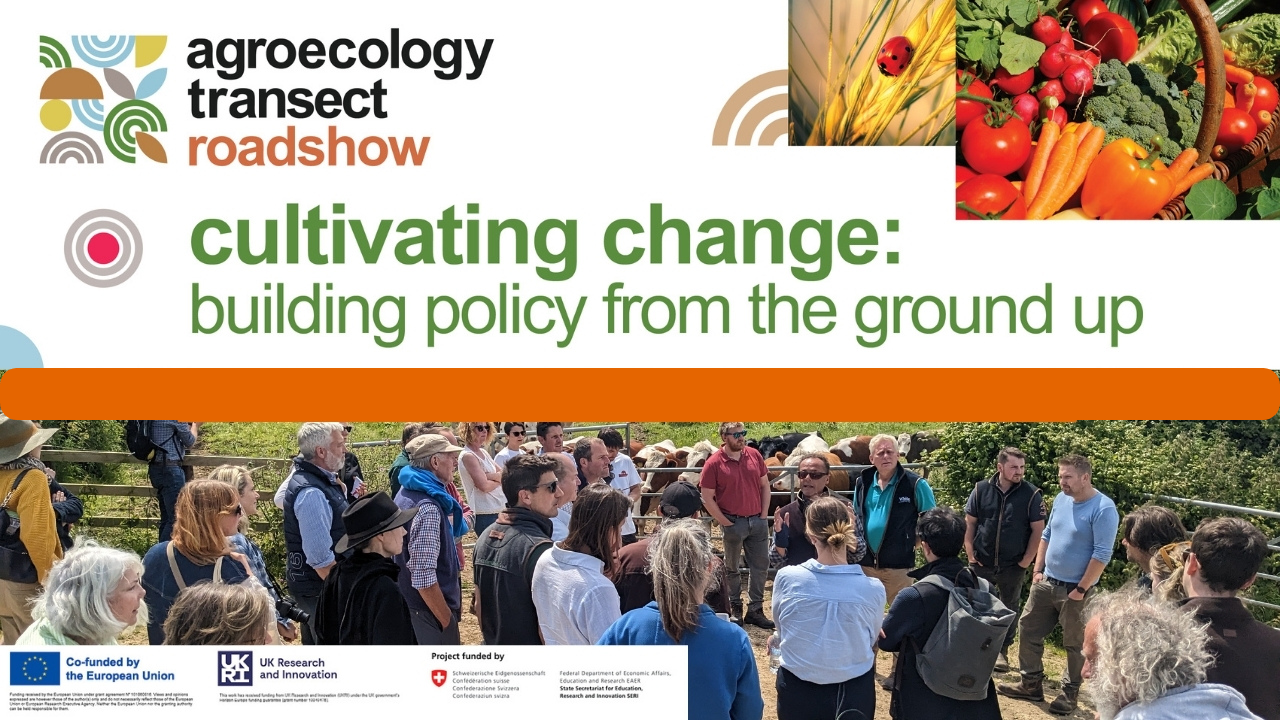
The virtual roadshow brings together key policy experts, researchers and innovation hub leads to co-create a shared vision of our food and farming sector that is rooted in resilience and ecological integrity. Watch the full recording here.
The Agroecology-Transect Project presents its third virtual roadshow for 2025 to deepen European farmers' knowledge of agroecological practices. Over the past three years, our partnership with 18 research organisations and 11 innovation hubs across Europe has unearthed why some agroecological farming practices thrive, while others struggle to gain traction. After three years of research and collaboration we have come together to share our insights and call for policies that enable real transitions towards agroecology in Europe.
“Unlocking the transition: Barriers and levers to the expansion of agroecology in the EU” was the first topic during the online event. Adrien Swartebroeckx, leader of the Agriculture and Sustainability Unit, Walloon Agricultural Research Centre, presented conclusions from research among 22 farmers, which aimed to identify what would help them or block them in their transition to agroecology.
Key barriers identified:
-
Awareness gaps regarding global challenges among farmers, consumers, and policymakers enhanced by regular policy shifts.
-
Policy inconsistencies of EU but also national, regional and local regulations related to agroecology. Аnd also the articulation between them.
-
Unsustainable subsidies and subsidy distribution which are insufficient and unfair for farms seeking to implement agroecological systems.
-
Market and regulatory challenges with a lack of adapted markets and unfair competition from imported products. For example, the MERCOSUR case, which is now under discussion at EU level.
-
Lack of rural attractiveness and infrastructure developments translating into disconnection from city and bigger markets.
-
Critical shortage of labor and young entrants driven by the low attractiveness of farming jobs. Especially stressed in the Mediterranean region. Even the farmers themselves are discouraging their children to do their job because it’s something difficult and not so fairly paid.
-
Technology and machinery limitations especially those adapted to agroecological practices – too expensive.
-
A lack of public research and co-creation of knowledge that would enable the development of context-specific, long-term solutions. This is something the project is trying to address through its Innovation Hubs initiative.
-
Climate uncertainties – research results and practices that work today may not be effective tomorrow.
Steven Lighthizer from Wageningen University and Research Center, Netherlands, spoke about the impacts, potentials and challenges in transdisciplinary research.
Transdisciplinary research projects, such as Agroecology-Transect, have become a key tool for driving change to address the global challenges of environmentally sound and socially just agri-food systems in the EU. Their main goal is to engage farmers and other stakeholders with the work of scientists and participate in the research process to the greatest extent possible, in order to define questions, methods, etc. This generates knowledge that is not only general and generic, but also applicable and useful.