Adapting to climate change: lessons from dairy farmers and farmers (webinar summary)
On 28.02, an online seminar was held with the participation of experts, farmers and researchers. Examples and practices from mountain dairy farmers in the French Massif Central and farmers in Romania were shared. The text provides a summary of the main topics discussed during the event. You can watch the full recording here.
Across Europe, increasingly drier summers are being observed, accompanied by a general increase in precipitation variability. Climate change is making pasture farms increasingly vulnerable, as the availability of annual feed stocks becomes unpredictable. Farmers are now managing their farms in much more unpredictable conditions.
This is the case in the Massif Central, one of the largest grassland systems in Europe. Climate change is having a major impact on plant species and biodiversity, says Bertrand Dumont, a zoologist, agroecologist and researcher at the French National Institute of Agronomic Research.
Farmers there need to adapt to increase the resilience of their farms to increasingly long periods of drought. For example, they may change their production objectives, the breeds of animals they raise, the feed resources they rely on or their management practices. Adaptation strategies vary from farmers’ knowledge to geographical context, as drought is often influenced by altitude.
As part of the Agroecology-Transect project, interviews were conducted with 15 mountain dairy farmers in the Massif Central to identify the different motivations and scopes of adaptation.
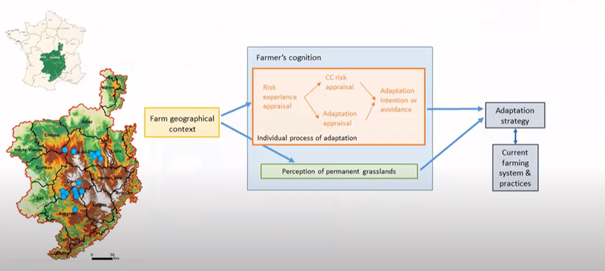
The blue dots indicate the locations of the farms participating in the study.
The strategies used by mountain dairy farmers depend on their willingness to adapt and their assessments of climate change. 4 out of 15 farmers believe that climate change is a risk to their farms and say they are ready and have already taken measures. 5 out of 15 plan to implement adaptation measures. They have not yet implemented them, but will certainly do so in the future. 3/15 are aware of the high risk, but do not have a high capacity for change. They prefer to adapt to specific dangers, but have not decided to take long-term measures. This, according to experts, is due to extreme thinking with a high dose of fatalism - they fear the scale of climate change, but believe that there is nothing they can do to influence it. This is especially true for the aging farmers in the region, who admit that they do not have the energy and time to implement changes on their farms yet and rather rely on the next generation.
Farmers in the southern hills, already experiencing severe drought, have little appreciation for the instrumental value of permanent pastures and are opting for temporary pastures and forage crop rotations to cope with climate variation. Rapid changes in these geographical locations reduce farmers’ capacity for long-term adaptation.
Cristina Necula runs her own organic farm in Romania. She is also a researcher at Wageningen University in the Netherlands and an agricultural consultant. Cristina tells us that farmers in Romania are aware that climate change is making extreme weather events more frequent and severe. The country is facing an increase in the frequency, intensity and duration of heat waves, especially in the southeast. At the same time, extreme rainfall, landslides and floods are becoming more frequent. Winters have recently been shorter, with less snowfall, making summers even drier. 2024 was recorded as the warmest year on record, and the forecast is not promising – a reduction in natural water resources for irrigation, especially in the river basins of Southern and Eastern Romania, where one of the eleven research centers under the Agroecology-Transect project is located.
Climate variability at the farm level is a source of recurring disturbances on both ecological and market factors. This has an impact on farm yields and incomes. Monocultures are preferred over more diverse crops, which are part of the solution. The preparation of farmers in Romania, according to the study Petrescu-Mag et al. 2022 / Micu et al. 2022, mainly includes the cultivation of new crops, changing the growing season; increased irrigation; increased use of pesticides and more frequent use of GMO crops.
As part of the project, 30 in-depth interviews were conducted with farmers in order to identify adaptation measures in terms of farming practices and financial strategies. The most common responses included:
• use of risk management tools against price vulnerability (80% of respondents);
• new or changed tillage practices (70% of respondents);
• purchased agricultural insurance (70% of respondents);
• included legumes/niche crops in the rotation (65% of respondents);
• integration of other side activities besides crop production (60% of respondents);
• use of cover crops (60% of respondents);
• installation of an irrigation system (57%);
• priority planting of drought-resistant local varieties (45%);
• refusal to plant sensitive crops (38%);
• changes in the fertilization system (30%);
• transition to organic farming (25%).
From these, three main types of adaptation strategies can be derived, ordered according to their prevalence and preference by farmers:
1) Irrigation for conventional agriculture: additional water as the only way to survive. High winter crop losses in extreme years, low summer crop losses due to irrigation. The strategy with the lowest long-term adaptive capacity.
2) Transition to conservation agriculture and market niches: minimum tillage as a necessary change. Moderate winter crop losses and high summer crop losses. Medium adaptive capacity.
3) Ecological and economic diversification as a way forward. Low to moderate yield losses in winter and summer crops. The strategy with the greatest long-term adaptive capacity.
The full diversity of agroecological practices at field level, together with financial risk management, will enable farmers to respond effectively to increasing climate variability in the lowlands of southern Romania. They require attention and knowledge, but are a long-term solution to a deepening crisis.