CAP in 2026: the Big Budget overhaul. Key EU Policy Moments to Watch
А great deal of important reforms in the Common Agricultural Policy (CAP) have already started in these first months of 2026. The EU leaders are freewheeling in the direction of free-trade deals. Would we remember it as the year that opened up opportunities for new genetic technologies in agriculture? Moreover, the future of seeds is at stake, with upcoming trilogues that will make or break the proposed overhaul of the EU’s Seed Law. And also, would pensioners be excluded from direct payments? And is it possible for the farmers to finally get a paid day off?
The following text is adapted from an article, published in the informational platform ARC 2020.
Anyone hoping for a quiet start to the year for the agricultural sector, surely was sadly mistaken. Between the war in the Middle East and trade deals pushed through left, right and centre, the situation for the food industry has become increasingly intense. Ahead in the horizon is the battle for the next CAP budget for 2028-2034 (the so called “multiannual financial framework”), which is expected to be bigger than ever. Because with the EU tightening its belt and redirecting money towards the bloc’s long-term budget, it’s all to play for other priorities to get a slice of the EU money pie Discussions have been ongoing since the announcement of the Commission’s Big Budget Bombshell that would radically restructure its funding programmes, pooling EU funds together into one money pot. This would merge agricultural funding with other funding streams, such as cohesion and migration. Funding would then be allocated on the basis of national plans, giving member states considerable discretion over how and where to direct money.
February saw the first real debate among political groups in the Parliament’s budget committee on the 2028–2034 budget — and so far, nobody seems happy with the proposal on the table. The heat of the budget battle is expected to spread out in the summer, as both legislators (the Parliament and the Counsil) will start working on their own position before trying to reach a final agreement. Once the financial negotiations are finalized, we will learn more about the shape and size of the CAP subsidy program.
CAP during the year
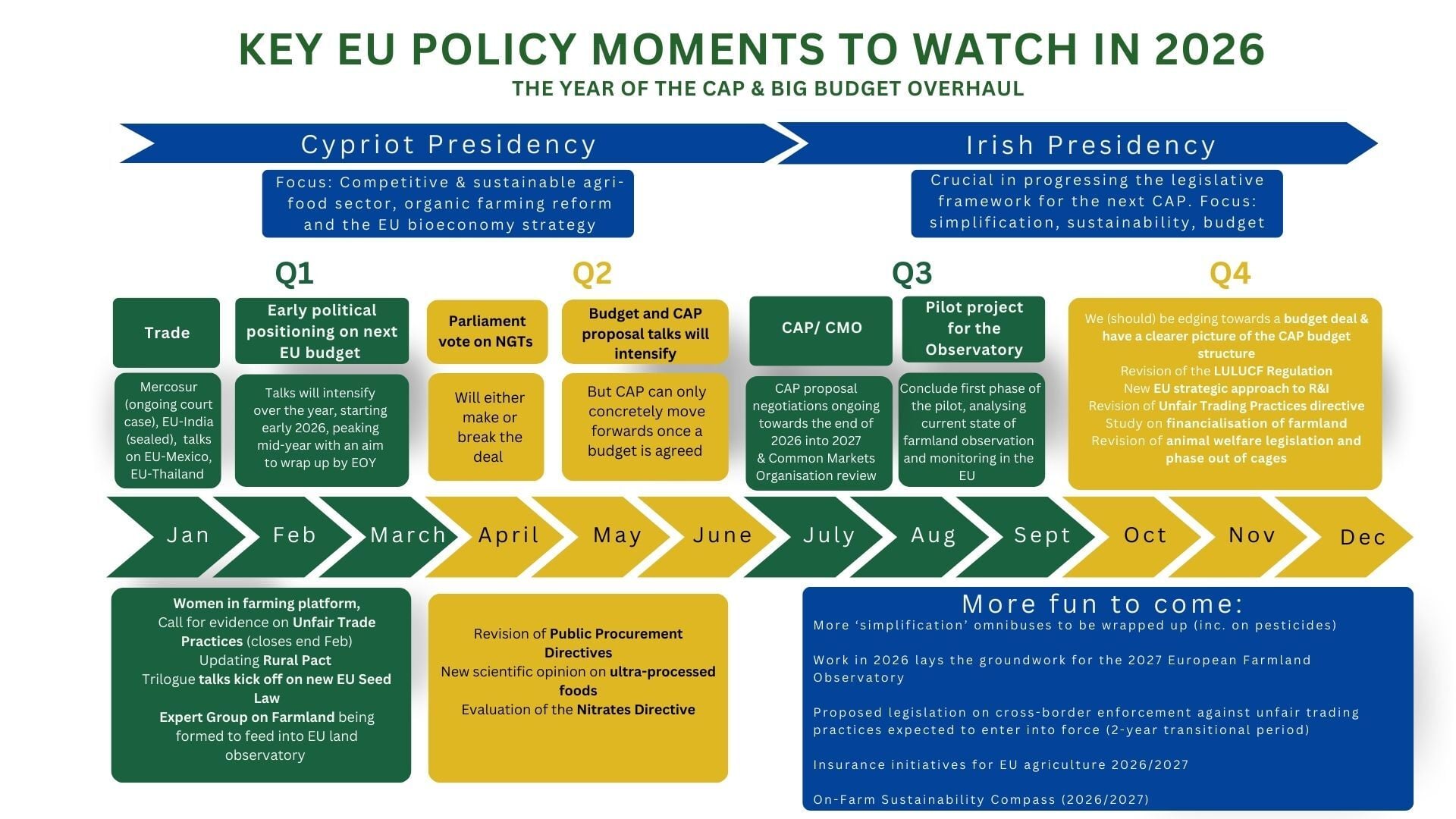
Other important discussions that will likely tighten this summer and should not be missed are:
-
How much power member states should have in steering a supposedly ‘common’ agricultural policy and what this means for any EU level ambition?
-
Is the proposal for stopping direct payment for pensioners fair?
-
To what extent should the CAP address social issues, including proposals to provide farmers with paid leave and sick leave.
Seeds
April may well bring the final sealing of the deal on EU plans to loosen the rules on the use of new GMOs — the so-called new genetic technologies — but it’s not a done deal just yet. The proposal still needs approval from the Parliament and a final green tick from the Council — but lawmakers in the Parliament are not happy with the deal that was agreed back in December, which crosses a number of their red lines. This includes the use of patents as well as questions around sustainability definitions and breeders exemptions.
Meanwhile, talks have just entered their final phase on the proposal to overhaul the EU’s seed law, the so-called Plant Reproductive Materials (PRM — see Seeds4All’s latest legal update),which stands to fundamentally change the way seeds are traded and exchanged in the EU.
Trade tensions
All of this is happening against the backdrop of wider geopolitical tensions, which are pushing EU leaders towards free-trade deals at breakneck speed. We already saw the sealing of the Mercosur trade deal back in January. Although it has been contested in courts, the EU has opened its door for and agreement with India, Mexico and Thailand in bids to diversify global allies.
At the same time, the EU is busy with its new “Buy European” drive, Commission President Ursula von der Leyen’s bid to strengthen European businesses. It’s interesting in principle, with the aim to strengthen local supply chains via tools like public procurement schemes. But it already has divided European leaders, some of whom are concerned with its protectionist flavour.
Either way, 2026 is shaping up to be a decisive one for the future of our food systems, and eyes should be firmly on Brussels for all the twists and turns that will inevitably come.
The following text is adapted from an article, published in the informational platform ARC 2020.